////////////////////////
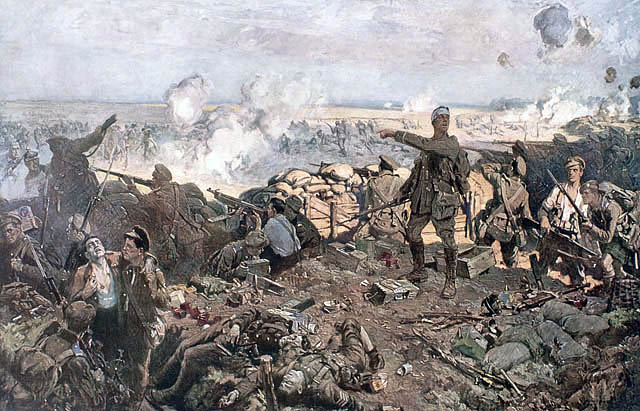
Second Battle of Ypres
During World War I, the Second Battle of Ypres was fought from 22 April – 25 May 1915 for control of the strategic Flemishtown of Ypres in western Belgium after the First Battle of Ypres the previous autumn. It was the first mass use by Germany ofpoison gas on the Western Front. For the first time, a former colonial force (the 1st Canadian Division) defeated a European power (the German Empire) on European soil (in the battles of St. Julien and Kitcheners' Wood, engagements during the battle).
The Ypres salient followed the canal, bulging eastward around the town. North of the salient, the Belgian army held the line of the Yser, and the northern end of the salient was held by two French divisions.[6] The eastern part of the salient was defended by one Canadian and two British divisions. The II Corps and V Corps of the Second Army comprised the 1st, 2ndand 3rd Cavalry Divisions and the 4th, 27th, 28th, Northumbrian, Lahore and 1st Canadian Divisions
In the hamlet of Gravenstafel (50.891°N 2.979°E) at about 5:00 p.m. on 22 April, the German Army released 168 long tons (171 t) of chlorine gas over a 6.5 km (4.0 mi) front on the line held by French Territorial and colonial Moroccan and Algeriantroops of the French 45th and 87th divisions.[8] Although poison gas had been used before, at the Battle of Bolimów three months earlier, the gas had liquified in the cold and become inert.
German troops carried 5,730 gas cylinders, weighing 90 pounds (41 kg) each, to the front by hand. The cylinders, opened by hand, relied on the prevailing wind to carry the gas towards enemy lines. Because of this method of dispersal, a large number of German soldiers were injured or killed while carrying out the attack.[9]

The French troops in the path of the gas cloud sustained about 6,000 casualties. Many died within ten minutes (primarily from asphyxiaand tissue damage in the lungs), and many more were blinded. Chlorine gas forms hypochlorous acid when combined with water, destroying moist tissue such as the lungs and eyes. The chlorine gas, denser than air, quickly filled the trenches and forced the troops out into heavy enemy fire.[10]
Although many French troops ran for their lives, others stood their ground and waited for the cloud to pass. Field Marshal Sir John French, Commander-in-Chief of the British Army, wrote:

No comments:
Post a Comment