Sunday, September 18, 2016

Versailles Treaty

http://www.history.ucsb.edu/faculty/marcuse/classes/33d/projects/1920s/CarlosTreaty.htm


//////////

 Versailles Treaty

World War I ended in 1919 with the signing of the Treaty of Versailles in the Hall of Mirrors. Symbolically, it was the same place where Otto von Bismarck had celebrated the French defeat in 1871 by proclaiming a German Empire, after the Franco-Prussian war that finalized the unification of the German state and signaled the rise of Germany’s military power. The treaty was finalized by the victors in late April and handed to the German representatives on May seventh. The German populace believed that the treaty was unfair. The Germans tried to have changes done to the treaty, but their efforts were futile. The allies threatened with the continuation of hostilities and the starvation blockade unless the Germans signed: "…in 1919…not only refused to accept the German reservations, but gave twenty-four hours within which to sign without conditions, in default of which the troops would march" (Dawson, 82). German’s military commanders, fully aware that the German military could not form any strong defense, advocated the signing of the treaty. The treaty was signed by Germany on June, 28, 1919.
There was immediate condemnation of the Versailles Treaty by the German populace. The German state was not expecting to lose the War. When the dust settled and the harsh reality of defeat was made clear, the German people were dumbfounded. It was a military defeat, but also a psychological defeat for the German state. "…the German people were expecting victory and not defeat. It was the acknowledgement of defeat, as much as the treaty terms themselves, which they found so hard to accept" (Henig, 27). The terms which caused the most resentment in Germany were the loss of territory, the war guilt placed solely on Germany, the deliberate effacement of the German military and the demands of reparations.

German Loss of Territory
The loss of territory meant an effacement of the German empire that Otto von Bismarck had established under the Prussian Monarchy. The reality of defeat and the fragmentation of the German empire were humiliating to the Germans. Germany lost 13.5 % of its territory under the terms of the treaty. Close to seven million German citizens were placed under the jurisdiction of a foreign nation

France: France took Alsace and Lorraine and the German coal mines in the Saar Region for fifteen years. The Saar region was a highly industrialized region.
Poland: the state of Poland was recreated. Poland took most of West Prussia and much of the Posen province. Upper Silesia was ceded to Poland, but later returned to Germany under a plebiscite. The Polish Corridor was made of land that belonged to Germany before WWI.
Belgium: Small areas of Eupen, Malmèdy, Moresńet, St. Vith
Denmark: Northern Schelswig was ceded to Denmark under article 27 of treaty.
Czechoslovakia: border area near Troppau (present day Opava)
The League of Nations took control of the free city of Danzig and the allies took control of the Rhineland for fifteen years. The Rhineland was demilitarized under article 180 of the Versailles Treaty. It was considered the industrial heart of Germany and the source of its military power. Germany also lost its colonies and large merchant 


War Guilt Clause

At the conclusion of the war, Germany was demonized due to the destruction that WWI had caused. All people affected by the war wanted Germany to be punished. It is erroneous to place the full burden of the war on Germany, "Belief in the unique guilt of the Kaiser for the horrors of the World War was unanimous" (Birdsall, 4). The politicians wanted Germany to accept moral responsibility for the war and all the consequences thereof, after realizing that Germany would not be able to pay reparations as high as 33 million. The politicians arrogantly believed they could appease their states by forcing the Germans to admit to a moral responsibility, since it became clear that Germany would not be able to pay high reparations. The accord was reached on April 7, 1919 and adopted as article 231 of the Versailles Treaty:


"The Allied and Associated Governments affirm and Germany accepts the responsibility of Germany and her allies for causing all the damage to which the allied and Associated Governments and their nationals have been subjected as a consequence of war imposed upon them by the aggression of Germany and her allies" (Birdsall, 254).
The political consequence of Article 231 was far reaching. Article 231 was termed the ‘War Guilt Clause.’ "This clause, more than any other in the entire Treaty of Versailles, was to cause lasting resentment in Germany…" (Henig, 19). The guilt clause resulted in German humiliation and rage. Most sectors of German society did not understand why all the blame was placed on the German state.

Dismemberment of German Military Force
The Allied forces were concerned with weakening Germany militarily. Numerous restrictions were placed on Germany’s military. Germany was forbidden to possess submarines and naval aircraft. Under the treaty Germany was limited to:
  • 6 battleships
  • 6 light cruisers
  • 12 destroyers
  • 12 torpedo boats
  • Navy could not have more than 1500 officers 
When Germany realized that they would not be keeping their Navy, it was decided that it was better to "…sink the fleet on June 22, 1919, when it became clear that, whatever was decided, the ships would not be allowed to return to Germany" (Henig, 17).
Similarly the German Army was to be limited:
  • Forbidden to use tanks, military aircraft or heavy artillery
  • The Army was to be a volunteer army no larger then 100, 000
The restrictions placed upon Germany were taken bitterly by the Germans. They argued that so many restrictions made them vulnerable to attack. The great German army had been dismantled and that was another humiliating factor of the Versailles Treaty. The Germans had venerated their military superiority since the German wars of unification

German Reparations
Reparations were another factor that led to the German resentment regarding the treaty. France and Britain, both wanted to receive reparations for the damage caused by Germany during the war. At first it was not agreed on the price that Germany should pay, financial reparations as high as 30,000 million were argued during the deliberation of the treaty. A question however lingered, how was Germany to pay such sums if the war had crippled her economy? To resolve this issue, it was agreed that Germany should only be responsible for civilian damage. The sum was set at 6,000 million, which was still very high due to the depreciated German economy.
France above all was the one who wanted to maintain Germany weak. France wanted to repay war debts with German capital. In 1923, the French invaded the Ruhr. In December 1922, the Reparations Commission declared that Germany had defaulted in its deliveries of timber. The French military invasion of the Ruhr spurred German nationalistic sentiments of hostility towards the French. Instead of giving the reparations, the German authorities encouraged the workers to strike. The result was a period of hyperinflation. The German mark, which had been under pressure since 1919, began to depreciate and eventually became worthless. Germans were desperate and were ready to support extremists such as Hitler and the Nazi Party:
"The invasion of the Ruhr in 1923 had been the most serious consequence. Within Germany…diminished the support for the Weimar government. Extremist parties on the right and left were given a boost, because of the alarm at the prospect of complete economic collapse and social disorder. Many historians argue that the invasion of the Ruhr paved the way for Hitler’s subsequent rise to power" (Henig, 35).
Hitler’s Views Concerning the Versailles Treaty
Hitler was very upset when Germany surrendered in November 1918 and firmly believed that Jewish politicians had stabbed Germany in the back. Germans hated the Versailles Treaty and viewed the June 28, the signing of the treaty as a day of dishonor for the German state. Hitler’s main objective and argument was that he was going to make Germany great again. He argued that in for Germany to regain its status of greatness, he Versailles Treaty had to be abolished. Hitler begun by proclaiming that he was going to liberate the German people of the dictated treaty.
Extracts from the Nazi Party Programme 1920
  • We demand the union of all Germans into a greater Germany.
  • We demand that Germany be treated in the same way as other countries and we demand the annulling of the Treaty of Versailles.
  • We demand land for our growing population.[http://www.redruth.cornwall.sch.uk/departments/History/gcse/germany/Germany1918-1939.htm]
Hitler in essence promised the German people the effacement of the Versailles Treaty. In doing so he paved the way to World War II. The German people argued that it was a dictated treaty, due to the fact that Germany had no say and this caused immense bitterness. Hitler’s popularity, in large part was due to his outspoken denunciation of the treaty. He promised that he was going to reunite all Germans under the fatherland once again. The German populace was in a state of distraught. Hitler used their sentiments to come to power. He began to disregard the Treaty of Versailles when he took Germany out of the League of Nations. Germany starts rearming in 1933. Hitler bolstered that by 1940 Germany would be fully prepared for war. He occupies the Rhineland in 1936. To fulfill his promise of reuniting all Germans once again, Hitler first unites with Austria in what is termed the Anschluss. The union of Austria and Germany was forbidden by the treaty. He then negotiates with the British Prime Minister, Chamberlain, to and obtains Sudetenland, and Czechoslovakia. By 1939, Hitler has literally abolished the dictated treaty and World War II begins in 1939 with the invasion of Poland.

Saturday, September 17, 2016

ww1 timeline

http://history1900s.about.com/od/1910s/a/WWI-Timeline.htm

1916 Battle of the Somme begins

http://www.history.com/this-day-in-history/battle-of-the-somme-begins


///////////////////////////////

1916

Battle of the Somme begins

At 7:30 a.m., the British launch a massive offensive against German forces in the Somme River region of France. During the preceding week, 250,000 Allied shells had pounded German positions near the Somme, and 100,000 British soldiers poured out of their trenches and into no-man’s-land on July 1, expecting to find the way cleared for them. However, scores of heavy German machine guns had survived the artillery onslaught, and the infantry were massacred. By the end of the day, 20,000 British soldiers were dead and 40,000 wounded. It was the single heaviest day of casualties in British military history. The disastrous Battle of the Somme stretched on for more than four months, with the Allies advancing a total of just five miles.
When World War I broke out in August 1914, great throngs of British men lined up to enlist in the war effort. At the time, it was generally thought that the war would be over within six months. However, by the end of 1914 well over a million soldiers of various nationalities had been killed on the battlefields of Europe, and a final victory was not in sight for either the Allies or the Central Powers. On the Western Front–the battle line that stretched across northern France and Belgium–the combatants had settled down in the trenches for a terrible war of attrition. Maimed and shell-shocked troops returning to Britain with tales of machine guns, artillery barrages, and poison gas seriously dampened the enthusiasm of potential new volunteers.
With the aim of raising enough men to launch a decisive offensive against Germany, Britain replaced voluntary service with conscription in January 1916, when it passed an act calling for the enlistment of all unmarried men between the ages of 18 and 41. After Germany launched a massive offensive of its own against Verdun in February, Britain expanded the Military Service Act, calling for the conscription of all men, married and unmarried, between the ages of 18 and 41. Near the end of June, with the Battle of Verdun still raging, Britain prepared for its major offensive along a 21-mile stretch of the Western Front north of the Somme River.
For a week, the British bombarded the German trenches as a prelude to the attack. British Field Marshal Douglas Haig, commander of the British Expeditionary Force, thought the artillery would decimate the German defenses and allow a British breakthrough; in fact, it served primarily to remove the element of surprise. When the bombardment died down on the morning of July 1, the German machine crews emerged from their fortified trenches and set up their weapons. At 7:30 a.m., 11 British divisions attacked at once, and the majority of them were gunned down. The soldiers optimistically carried heavy supplies for a long march, but few made it more than a couple of hundred yards. Five French divisions that attacked south of the Somme at the same time fared a little better, but without British success little could be done to exploit their gains.
After the initial disaster, Haig resigned himself to smaller but equally ineffectual advances, and more than 1,000 Allied lives were extinguished for every 100 yards gained on the Germans. Even Britain’s September 15 introduction of tanks into warfare for the first time in history failed to break the deadlock in the Battle of the Somme. In October, heavy rains turned the battlefield into a sea of mud, and on November 18 Haig called off the Somme offensive after more than four months of mass slaughter.
Except for its effect of diverting German troops from the Battle of Verdun, the offensive was a miserable disaster. It amounted to a total gain of just 125 square miles for the Allies, with more than 600,000 British and French soldiers killed, wounded, or missing in the action. German casualties were more than 650,000. Although Haig was severely criticized for the costly battle, his willingness to commit massive amounts of men and resources to the stalemate along the Western Front did eventually contribute to the collapse of an exhausted Germany in 1918.

Battle of Verdun is considered the greatest and lengthiest in world history


The postponed attack of  12 February 

The attack on Verdun was originally planned on Saturday 12 February. On the night of the 11th /12th of February the German troops were placed in position. The German infantry was waiting in their 'stollen', thousands at a time, for the starting signal. At the very last moment the attack was cancelled. It had began to snow and rain severely, it was freezing, the wind had increased and turned into a storm and the visibility was very poor. A large part of the German troops had to remain in the very primitive 'stollen' that were not equipped for a long stay. The 'stollen' were not heated and flooded. The overall condition of the troops got worse every day because of stomach and colon problems and malnutrition. After nine days of hardships the weather conditions had improved in such a way that the signal for attack could be given. Most likely the delay saved France from defeat: the two French divisions, which had been appointed as reinforcements at the very last moment, could therefore be placed into position. It also gave them the opportunity to make last minute improvements in their defence.


////////////////////////////////////////

The Battle of Verdun is considered the greatest and lengthiest in world history. Never before or since has there been such a lengthy battle, involving so many men, situated on such a tiny piece of land. The battle, which lasted from 21 February 1916 until 19 December 1916 caused over an estimated 700,000 dead, wounded and missing. The battlefield was not even a square ten kilometres. From a strategic point of view there can be no justification for these atrocious losses. The battle degenerated into a matter of prestige of two nations literally for the sake of fighting......


The start of the German attack

Monday morning 21 February 7.15 
  The heaviest bombing that had thus far ever taken place in a war starts over the entire Verdun front on the left and right side of the river Meuse and had a frontal latitude of 40 kilometres. Verdun itself is also heavily bombarded; the entire civilian population is evacuated.
The bombardment is the most horrible thus far; a terrible inferno. The muzzling fire from the German guns is one uninterrupted sea of fire. Black grenades fall with a frequency of 40 a minute. [Note: later made estimations show that in a rectangular of 500 by 1000 meter, 80.000 (sic) heavy grenades have fallen.]


September 5 - Tsar Nicholas II takes personal control over Russia's armies.


//////////////////////////

January 17, 1915 - The initial Turkish offensive into Russia is thwarted as the Turkish 3rd Army suffers a defeat by the Russian Army of the Caucasus near Kars. The Russians then begin a multi-pronged invasion of the Ottoman Empire from the Caucasus.
January 19, 1915 - Germany begins an aerial bombing campaign against Britain using Zeppelins.
January 31, 1915 - Poison gas is used for the first time in the war as Germans on the Eastern Front attack Russian positions west of Warsaw. Although the Germans fire 18,000 gas shells, they have little effect on the Russians as frigid temperatures prevent the gas from vaporizing.
February 1915 - The Turks begin forced deportations of Armenians. Over the next two years, an estimated 1.5 million Armenians will either starve to death, die of thirst in the Syrian Desert, or be murdered by Turkish troops and bandits, during the Armenian Genocide.
February 3, 1915 - Turkish troops launch an unsuccessful attack against the British-controlled Suez Canal, which is regularly used by the British to ferry Dominion troops from Australia, New Zealand and India to European battle grounds.
February 4, 1915 - Germany declares the waters surrounding British Isles to be a war zone in which ships can be sunk without warning.
February 7-22, 1915 - On the Eastern Front in Europe, the German 8th and 10th Armies wage a successful offensive against the Russian 10th Army in the Masurian Lakes region of East Prussia, pushing the Russians eastward into the Augustow Forest where they are decimated.
February 16, 1915 - On the Western Front, the French launch their second offensive against German defense lines in Champagne. Once again they are hampered by the muddy winter weather and a lack of heavy artillery. After a month of fighting, suffering 240,000 casualties, the exhausted French break off the offensive.
U-Boat Warfare Begins
February 18, 1915 - The first German U-Boat campaign of the war begins with unrestricted attacks against merchant and passenger ships in the waters around the British Isles. Within six months, Allied shipping losses at sea surpass the number of new ships being built. However, the unrestricted attacks also arouse the anger of the neutral United States as Americans are killed.
March 1915 - The British Navy imposes a total sea blockade on Germany, prohibiting all shipping imports including food.
March 10, 1915 - British and Indian troops in the Artois region of northern France attack the Germans around the village of Neuve Chapelle. The attack takes the outnumbered Germans by surprise. The British achieve their initial objective but fail to capitalize on the narrow breach they create in the German lines. After three days of fighting, with over 11,000 casualties, the British offensive is suspended. The Germans suffer over 10,000 casualties.
March 22, 1915 - The Russians capture 120,000 Austrians at Przemysl in Galicia. This marks the culmination of a series of winter battles between the Austrians and Russians to secure the strategic Carpathian Mountain passes and opens the way for a Russian invasion of Hungary. Realizing this, the Germans and Austrians make plans to combine their troops and launch a major spring offensive.
April 11, 1915 - British troops in Mesopotamia fend off a large attack by the Turks against Basra. The British then branch out to protect their position at Basra, and proceed up the Tigris Valley toward Baghdad.


The History Place - World War I

Second Battle of Ypres


////////////////////////
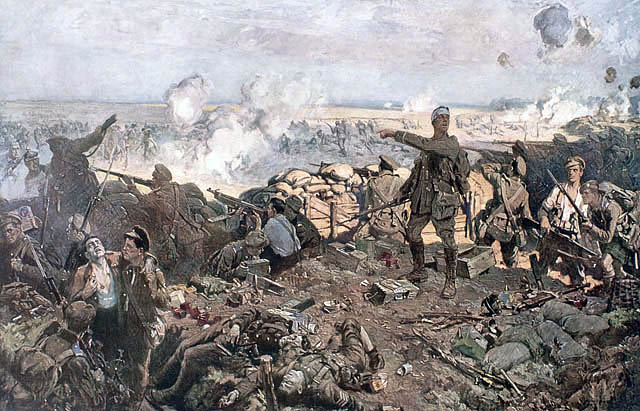
File:The Second Battle of Ypres.jpg

Second Battle of Ypres

During World War I, the Second Battle of Ypres was fought from 22 April – 25 May 1915 for control of the strategic Flemishtown of Ypres in western Belgium after the First Battle of Ypres the previous autumn. It was the first mass use by Germany ofpoison gas on the Western Front. For the first time, a former colonial force (the 1st Canadian Division) defeated a European power (the German Empire) on European soil (in the battles of St. Julien and Kitcheners' Wood, engagements during the battle).

The Ypres salient followed the canal, bulging eastward around the town. North of the salient, the Belgian army held the line of the Yser, and the northern end of the salient was held by two French divisions.[6] The eastern part of the salient was defended by one Canadian and two British divisions. The II Corps and V Corps of the Second Army comprised the 1st2ndand 3rd Cavalry Divisions and the 4th27th28thNorthumbrianLahore and 1st Canadian Divisions

In the hamlet of Gravenstafel (50.891°N 2.979°E) at about 5:00 p.m. on 22 April, the German Army released 168 long tons (171 t) of chlorine gas over a 6.5 km (4.0 mi) front on the line held by French Territorial and colonial Moroccan and Algeriantroops of the French 45th and 87th divisions.[8] Although poison gas had been used before, at the Battle of Bolimów three months earlier, the gas had liquified in the cold and become inert.
German troops carried 5,730 gas cylinders, weighing 90 pounds (41 kg) each, to the front by hand. The cylinders, opened by hand, relied on the prevailing wind to carry the gas towards enemy lines. Because of this method of dispersal, a large number of German soldiers were injured or killed while carrying out the attack.[9]
Soldiers wearing white surgical-type masks
Belgian troops wearing early gas masks, 1915
The French troops in the path of the gas cloud sustained about 6,000 casualties. Many died within ten minutes (primarily from asphyxiaand tissue damage in the lungs), and many more were blinded. Chlorine gas forms hypochlorous acid when combined with water, destroying moist tissue such as the lungs and eyes. The chlorine gas, denser than air, quickly filled the trenches and forced the troops out into heavy enemy fire.[10]
Although many French troops ran for their lives, others stood their ground and waited for the cloud to pass. Field Marshal Sir John French, Commander-in-Chief of the British Army, wrote:
 ... I wish particularly to repudiate any idea of attaching the least blame to the French Division for this unfortunate incident. After all the examples our gallant Allies have shown of dogged and tenacious courage in the many trying situations in which they have been placed throughout the course of this campaign it is quite superfluous for me to dwell on this aspect of the incident, and I would only express my firm conviction that, if any troops in the world had been able to hold their trenches in the face of such a treacherous and altogether unexpected onslaught, the French Division would have stood firm.

Battle of Gallipoli


February 19, 1915: British and French begin to attack Dardanelles


The Gallipoli Campaign of 1915-16, also known as the Battle of Gallipoli or the Dardanelles Campaign, was an unsuccessful attempt by the Allied Powers to control the sea route from Europe to Russia during World War I. The campaign began with a failed naval attack by British and French ships on the Dardanelles Straits in February-March 1915 and continued with a major land invasion of the Gallipoli Peninsula on April 25, involving British and French troops as well as divisions of the Australian and New Zealand Army Corps (ANZAC). Lack of sufficient intelligence and knowledge of the terrain, along with a fierce Turkish resistance, hampered the success of the invasion. By mid-October, Allied forces had suffered heavy casualties and had made little headway from their initial landing sites. Evacuation began in December 1915, and was completed early the following January.
With World War I stalled on the Western Front by 1915, the Allied Powers were debating going on the offensive in another region of the conflict, rather than continuing with attacks in Belgium and France. Early that year, Russia’s Grand Duke Nicholas appealed to Britain for aid in confronting a Turkish invasion in the Caucasus. (The Ottoman Empire had entered World War I on the side of the Central Powers, Germany and Austria-Hungary, by November 1914.) In response, the Allies decided to launch a naval expedition to seize the Dardanelles Straits, a narrow passage connecting the Aegean Sea to the Sea of Marmara in northwestern Turkey. If successful, capture of the straits would allow the Allies to link up with the Russians in the Black Sea, where they could work together to knock Turkey out of the war.
Spearheaded by the first lord of the British Admiralty, Winston Churchill (over the strong opposition of the First Sea Lord Admiral John Fisher, head of the British Navy), the naval attack on the Dardanelles began with a long-range bombardment by British and French battleships on February 19, 1915. Turkish forces abandoned their outer forts but met the approaching Allied minesweepers with heavy fire, stalling the advance. Under tremendous pressure to renew the attack, Admiral Sackville Carden, the British naval commander in the region, suffered a nervous collapse and was replaced by Vice-Admiral Sir John de Robeck. On March 18, 18 Allied battleships entered the straits; Turkish fire, including undetected mines, sank three of the ships and severely damaged three others.


//////////////////////

February 4, 1915, Germany declared the waters about the British Isles a "war zone"


////////////////////////
On February 4, 1915Germany declared the waters about the British Isles a "war zone" in which submarines would destroy every enemy merchant vessel found there. She warned neutrals that neither the crews nor passengers of such vessels, whether enemy or neutral subjects, would be safe in the zone. This was quite a different matter from the interference of the British with the trade rights of the United States. Compensation for property losses might be made after the war, but compensation for loss of lives as a result of the new German rules of submarine warfare was impossible.
    The sinking of the Lusitania. Events soon showed the German announcement to be no idle threat. British ships with Americans aboard and American vessels with their crews were destroyed. The outstanding horror of the submarine warfare was the sinking of the Lusitania, a British passenger and merchant ship, on May 7, 1915. Eleven hundred of the passengers and crew were drowned, including 128 American men, women, and children. (There is much controversy over the sinking of the Lusitania; it was not armed and had no troops; however, it did carry 4,200 cases of cartridges. The German Embassy had published advertisements in New York newspapers warning Americans not to sail on belligerent passenger ships.)
    Wilson's patient attitude. In their anger the people of the United States forgot about British restrictions on neutral trade. For the first time there arose a widespread demand that the United States should intervene. LikeJefferson after the Chesapeake-Leopard affair, Wilson after the attack on the Lusitania might have won from Congress support for a declaration of war against Germany. It would not, however, have represented the will of the united nation. West of the Mississippi the attitude toward the submarine issue was still one of indifference. Wilson was determined to make war the last resort. "The example of America," be said, "must be a special example . . . of peace, because peace is the healing and elevating influence of the world, and strife is not." Unfortunately the President obscured meaning of his high ideal by the phrase, "There is such a thing as a man being too proud to fight."


Battle of Ypres


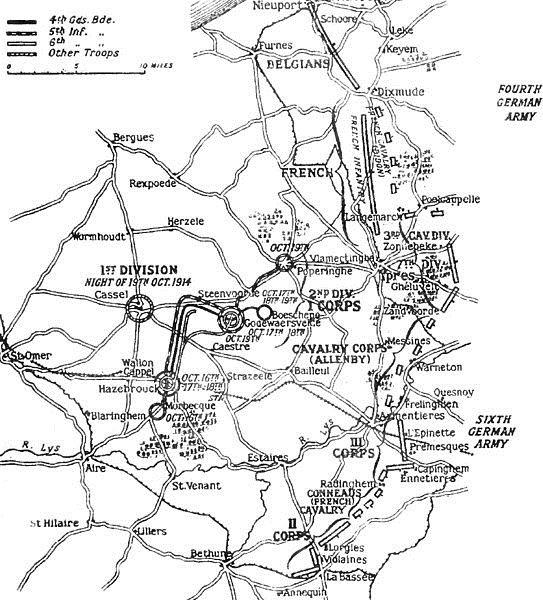
File:Locations of the Allied and German armies, 19 October 1914.png


///////////////////////////////////


////////////////////////////////

The First Battle of Ypres (FrenchPremière Bataille des Flandres GermanErste Flandernschlacht,19 October – 22 November) was a battle of the First World War, fought on the Western Front around Ypres, in westernBelgium, during October and November 1914. The battle was part of the First Battle of Flanders, in which GermanFrenchand Belgian armies and the British Expeditionary Force (BEF) fought from Arras in France to Nieuport on the Belgian coast, from 10 October to mid-November. The battles at Ypres began at the end of the Race to the Sea, reciprocal attempts by the German and Franco-British armies to advance past the northern flank of their opponents. North of Ypres, the fighting continued in the Battle of the Yser (16–31 October), fought between the German 4th Army and the Belgian army and French marines.
The fighting has been divided into five stages, an encounter battle from 19–21 October, the Battle of Langemarck from21–24 October, the battles at La Bassée and Armentières to 2 November, coincident with more Allied attacks at Ypres and the Battle of Gheluvelt (29–31 October), a fourth phase with the last big German offensive which culminated at the Battle of Nonne Bosschen on 11 November then local operations, which faded out in late November. Brigadier-General J. E. Edmonds, an official historian, wrote in the British History of the Great War, wrote that the II Corps battle at La Bassée could be taken as separate but that the battles from Armentières to Messines and Ypres, were better understood as a battle in two parts, an offensive by III Corps and the Cavalry Corps from 12–18 October), against which the Germans retired and an offensive by the German 6th Army and 4th Army from (19 October – 2 November), which from 30 October, took place mainly north of the Lys, when the battles of Armentières and Messines merged with the Battles of Ypres.[a]
Attacks by the BEF (Field Marshal Sir John French), the Belgians and the French Eighth Army in Belgium made little progress beyond Ypres and then the German 4th and 6th Armies took small amounts of ground at great cost to both sides, during the Battle of the Yser (16–31 October) and further south at Ypres. General Erich von Falkenhayn, head of the Oberste Heeresleitung (OHL, the Chief of the German General Staff, then tried a limited offensive to capture Ypres and Mount Kemmel, from (19 October – 22 November). Neither side had moved forces to Flanders fast enough to obtain a decisive victory and by November, both were exhausted, short of ammunition and suffering from collapses in morale; some infantry units refused orders. The autumn battles in Flanders had quickly become static, attrition operations, unlike the battles of manoeuvre in the summer. French, British and Belgian troops in improvised field defences, repulsed German attacks for four weeks. From 21–23 October, German reservists had made mass attacks at Langemarck, with losses of up to 70 percent, to little effect.
Warfare between mass armies, equipped with the weapons of the Industrial Revolution and its later developments, proved to be indecisive, because field fortifications neutralised many classes of offensive weapon. The defensive use of artillery andmachine guns had dominated the battlefield and the ability of the armies to supply themselves and replace casualties prolonged battles for weeks. The German armies engaged 34 divisions in the Flanders battles, the French twelve, the British nine and the Belgians six, along with marines and dismounted cavalry. Falkenhayn reconsidered German strategy over the winter, because Vernichtungsstrategie and a dictated peace against France and Russia had been shown to be beyond German resources. Falkenhayn intended to detach Russia or France from the Allied coalition, by diplomatic as well as military action. A strategy of attrition (Ermattungsstrategie), would make the cost of the war too great, until one enemy negotiated an end to the war. The remaining belligerents would have to negotiate or face the Germans concentrated on the remaining front, which would be sufficient to obtain a decisive victory.

On 9 October, the First German offensive against Warsaw began with the battles of Warsaw (9–19 October) and Ivangorod (9–20 October). Four days later, Przemyśl was relieved by the advancing Austro-Hungarians and the Battle of Chyrow13 October– 2 November) began in Galicia. Czernowitz in the Bukovina, was re-occupied by the Austro-Hungarian army on 22 August and then lost again to the Russian army on 28 October. On 29 October, the Ottoman Empire commenced hostilities against Russia, when Turkish warships bombarded Odessa, Sevastopol and Theodosia. Next day Stanislau in Galicia was taken by Russian forces and the Serbian army began a retreat from the line of the Drina. On 4 November, the Russian army crossed the frontier of Turkey-in-Asia and seized Azap.[1]
Britain and France declared war on Turkey on 5 November and next day, Keupri-Keni in Armenia was captured, during theBergmann Offensive (2–16 November) by the Russian army. On 10 October, Przemysl was surrounded again by the Russian army, beginning the Second Siege; Memel in East Prussia was occupied by the Russians a day later. Keupri-Keni was recaptured by the Ottoman army on 14 November, theSultan proclaimed Jihad, next day the Battle of Cracow (15 November – 2 December) began and the Second Russian Invasion of North Hungary (15 November – 12 December) commenced. The Second German Offensive against Warsaw opened with the Battle of Łódź (16 November – 15 December)

Great Retreat


The Great Retreat was a long withdrawal by the Franco-British armies to the Marne, from 24 August – 28 September 1914, after the success of the German armies in the Battle of the Frontiers (7 August – 13 September). After the defeat of the French Fifth Army at the Battle of Charleroi (21 August) and the BEF in the Battle of Mons (23 August), both armies made a rapid retreat to avoid envelopment.[b] A counter-offensive by the French and the BEF at the First Battle of Guise (29–30 August), failed to end the German advance and the Franco-British retreat continued beyond the Marne. From 5–12 September, the First Battle of the Marne ended the retreat and forced the German armies to retire towards the Aisne river, where the First Battle of the Aisne was fought from 13–28 September


1914 First Battle of the Marne begins


\\\\\\\\\\\\\\\\\\\\\\\\\\\\\\\\\


/////////////////////////////////////

1914

First Battle of the Marne begins


1914 Battle of Tannenberg begins


1914

Battle of Tannenberg begins


On August 26, 1914, the German 8th Army, under the leadership of Paul von Hindenburg and Erich Ludendorff, strikes with lethal force against the advancing Russian 2nd Army, led by General Aleksandr Samsonov, in East Prussia during the opening weeks of the First World War.
In the middle of August 1914, much sooner than had been anticipated, Russia sent two armies into East Prussia, while Germany, according to its war strategy, had the bulk of its forces concentrated to the west, against France. The Russian 1st Army, under General Pavel Rennenkampf, advanced to the northeastern corner of East Prussia, while Samsonov’s 2nd Army made headway into the southwest, planning to join with Rennenkampf’s men and pin the outnumbered German 8th Army between them. After a Russian victory in the Battle of Gumbinnen on August 20, however, Rennenkampf paused to regroup his forces.
Meanwhile, change was afoot behind the German lines: Helmuth von Moltke, chief of the German general staff, chose to replace the previous leader, Maximilian von Prittwitz, after the latter issued a misguided order for a German retreat to the River Vistula, against the advice of his corps commanders. Hindenburg, a retired general of great stature, and Ludendorff, who had just led the German capture of the Belgian fortress of Liege, arrived in East Prussia and immediately authorized an aggressive counter-action against the Russians, previously planned by a senior staff officer in the region, Colonel Max Hoffmann.
Separated by the great Masurian Lakes, the two Russian armies were unable to effectively communicate with each other as to their movements, a circumstance that would prove deadly. Though Ludendorff succumbed to nerves initially, delaying the start of the German attack by one day, Hindenburg was able to calm his subordinate—not for the last time in what would become a fabled partnership. On August 26, after intercepting uuencoded wireless messages from both Samsonov and Rennenkampf, the Germans were able to take Samsonov’s army by surprise with the force of their attack near the village of Tannenberg, to the southwest of the Masurian Lakes. The delay in starting the attack had given Samsonov’s forces more time to advance deeper into the sack formed by the German divisions enveloping them from both sides, the strength of which Samsonov consistently underestimated. After three days of battering by German artillery, Samsonov’s troops began their retreat; more German forces cut off their path and a massive slaughter ensued. In the first hours of August 30, confronting the reality of his army’s collapse, Samsonov went into the forest, away from his staff, and shot himself.
In total, over 50,000 Russian soldiers were killed and some 92,000 taken as prisoners in the Battle of Tannenberg—named thus by the Germans in vengeful remembrance of the village, where in 1410 the Poles had defeated the Teutonic Knights. By the end of August, Russia’s ambitious advance in East Prussia in August 1914 had achieved at least one of its goals, albeit at a tremendous cost: two German corps had been removed from the Western to the Eastern Front in order to confront the Russian menace. Though the two corps had not arrived in time to play a role in the Battle of Tannenberg—which would remain the greatest German triumph of the war against Russia on the Eastern Front— they would also be unable to aid their comrades at the Battle of the Marne in early September, when German forces advancing towards Paris were decisively defeated by British and French troops in a crucial victory for the Allies.


////////////////////

1914 Austria-Hungary declares war on Serbia


http://www.history.com/this-day-in-history/austria-hungary-declares-war-on-serbia


1914

Austria-Hungary declares war on Serbia


Threatened by Serbian ambition in the tumultuous Balkans region of Europe, Austria-Hungary determined that the proper response to the assassinations was to prepare for a possible military invasion of Serbia. After securing the unconditional support of its powerful ally, Germany, Austria-Hungary presented Serbia with a rigid ultimatum on July 23, 1914, demanding, among other things, that all anti-Austrian propaganda within Serbia be suppressed, and that Austria-Hungary be allowed to conduct its own investigation into the archduke’s killing. Though Serbia effectively accepted all of Austria’s demands except for one, the Austrian government broke diplomatic relations with the other country on July 25 and went ahead with military preparedness measures. Meanwhile, alerted to the impending crisis, Russia—Serbia’s own mighty supporter in the Balkans—began its own initial steps towards military mobilization against Austria.

In the days following the Austrian break in relations with Serbia, the rest of Europe, including Russia’s allies, Britain and France, looked on with trepidation, fearing the imminent outbreak of a Balkans conflict that, if entered into by Russia, threatened to explode into a general European war. The British Foreign Office lobbied its counterparts in Berlin, Paris and Rome with the idea of an international convention aimed at moderating the conflict; the German government, however, was set against this notion, and advised Vienna to go ahead with its plans.
On July 28, 1914, after a decision reached conclusively the day before in response to pressure from Germany for quick action—apart from Kaiser Wilhelm II, who by some accounts still saw the possibility of a peaceful diplomatic resolution to the conflict, but was outmaneuvered by the more hawkish military and governmental leadership of Germany—Austria-Hungary declared war on Serbia. In response, Russia formally ordered mobilization in the four military districts facing Galicia, its common front with the Austro-Hungarian Empire. That night, Austrian artillery divisions initiated a brief, ineffectual bombardment of Belgrade across the Danube River.


//////////////////////

Why did war break out in 1914?


/////////////////////////////

Why did war break out in 1914?Back to top back to top
The Great War of 1914-18 began in August 1914. The causes of this war have been debated by politicians and historians ever since. One of the few things that historians have been able to agree about is that the war was the result of many different complex factors working together. These factors meant that the situation in Europe in 1914 was very tense. This in turn allowed one crisis to spiral out of control and spark off a war that killed millions.
The war was fought between rival alliances of European powers:
  • In 1879, Germany and Austria-Hungary formed an alliance (the Dual Alliance) that gave them great strength in the centre of Europe.
  • In 1892, the French and the Russians formed their own strong alliance (the Dual Entente) that meant Germany now had an unfriendly power on each side.
  • Soon afterwards, Germany's most powerful soldier, General Schlieffen, drew up a plan that would allow Germany to beat France very quickly in any future war. This would then free most German troops to fight Russia in the east.
  • By the early 1900s, the alliances had developed. The Dual Alliance had become the Triple Alliance with Italy (although Italy stayed out of the war in 1914).
  • In 1907, Britain joined Russia and France to form the Triple Entente. Britain was much less committed to this alliance than Russia or France.

Germany declared war on France as part of a long-held strategy called the Schlieffen Plan.


n World War I, Germany declared war on France as part of a long-held strategy called the Schlieffen Plan. The Schlieffen Plan required German troops to organize on the frontier of Belgium, a neutral country, with the idea to invade France

Russia and Germany—declare war on each other

http://www.history.com/this-day-in-history/first-world-war-erupts-in-europe


1914

First World War erupts in Europe

On August 1, 1914, four days after Austria-Hungary declared war on Serbia, two more great European powers—Russia and Germany—declare war on each other; the same day, France orders a general mobilization. The so-called “Great War” that ensued would be one of unprecedented destruction and loss of life, resulting in the deaths of some 20 million soldiers and civilians and the physical devastation of much of the European continent.
The event that was widely acknowledged to have sparked the outbreak of World War I occurred on June 28, 1914, when Archduke Franz Ferdinand, heir to the Austro-Hungarian Empire, was shot to death with his wife by the Bosnian Serb nationalist Gavrilo Princip in Sarajevo. Over the weeks that followed, Austria-Hungary blamed the Serbian government for the attack, hoping to use the incident as justification for settling the problem of Slavic nationalism in the tumultuous Balkans region once and for all. However, as Russia supported Serbia, an Austria-Hungary declaration of war was delayed until its leaders received assurances from German leader Kaiser Wilhelm II that Germany would support their cause in the event of a Russian intervention. This assurance came on July 5; Austria-Hungary subsequently sent an ultimatum to the Serbian government on July 23 and demanded its acceptance within two days at the risk of war. Though Serbia accepted all but two of the ultimatum’s terms, and Russia declared its intention to back Serbia in the case of such a conflict, Austria-Hungary went ahead with its war declaration against Serbia on July 28, one month after the assassinations.
With that declaration, the tenuous peace between Europe’s great powers was shattered: Germany warned Russia, still only partially mobilized, that to continue to full mobilization against Austria-Hungary would mean war with Germany. While insisting that Russia immediately halt mobilization, Germany began its own mobilization; when the Russians refused the German demands, Germany declared war on the czarist empire on August 1. That same day, Russia’s ally, France, long suspicious of German aggression, began its own mobilization, urging Great Britain—the third member, along with France and Russia, of the Triple Entente alliance—to declare its support. A divided British government declined to do so initially, but events soon precipitated Britain’s move towards war as well. On August 2, the first German army units crossed into Luxembourg as part of a long-planned German strategy to invade France through neutral Belgium. France and Germany declared war against each other on August 3; that night, Germany invaded Belgium, prompting Great Britain to declare war on Germany.
For the most part, the people of Europe greeted the outbreak of war with jubilation. The great majority of people—within government and without—assumed that their country would be victorious within months, and could not envision the possibility of a longer conflict. By the end of 1914, however, well over a million soldiers of various nationalities had been killed on the battlefields of Europe, and there was no final victory in sight for either the Allies or the Central Powers. On the Western Front—the battle line that stretched across northern France and Belgium—the combatants settled down in the trenches for a terrible war of attrition, which would continue, in Europe and other corners of the world, for the next four years.