///////////////////////////////////

////////////////////////////////
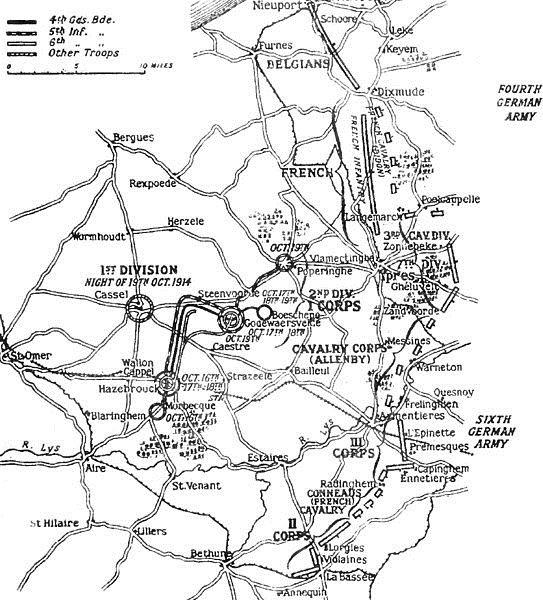
The First Battle of Ypres (French: Première Bataille des Flandres German: Erste Flandernschlacht,19 October – 22 November) was a battle of the First World War, fought on the Western Front around Ypres, in westernBelgium, during October and November 1914. The battle was part of the First Battle of Flanders, in which German, Frenchand Belgian armies and the British Expeditionary Force (BEF) fought from Arras in France to Nieuport on the Belgian coast, from 10 October to mid-November. The battles at Ypres began at the end of the Race to the Sea, reciprocal attempts by the German and Franco-British armies to advance past the northern flank of their opponents. North of Ypres, the fighting continued in the Battle of the Yser (16–31 October), fought between the German 4th Army and the Belgian army and French marines.
The fighting has been divided into five stages, an encounter battle from 19–21 October, the Battle of Langemarck from21–24 October, the battles at La Bassée and Armentières to 2 November, coincident with more Allied attacks at Ypres and the Battle of Gheluvelt (29–31 October), a fourth phase with the last big German offensive which culminated at the Battle of Nonne Bosschen on 11 November then local operations, which faded out in late November. Brigadier-General J. E. Edmonds, an official historian, wrote in the British History of the Great War, wrote that the II Corps battle at La Bassée could be taken as separate but that the battles from Armentières to Messines and Ypres, were better understood as a battle in two parts, an offensive by III Corps and the Cavalry Corps from 12–18 October), against which the Germans retired and an offensive by the German 6th Army and 4th Army from (19 October – 2 November), which from 30 October, took place mainly north of the Lys, when the battles of Armentières and Messines merged with the Battles of Ypres.[a]
Attacks by the BEF (Field Marshal Sir John French), the Belgians and the French Eighth Army in Belgium made little progress beyond Ypres and then the German 4th and 6th Armies took small amounts of ground at great cost to both sides, during the Battle of the Yser (16–31 October) and further south at Ypres. General Erich von Falkenhayn, head of the Oberste Heeresleitung (OHL, the Chief of the German General Staff, then tried a limited offensive to capture Ypres and Mount Kemmel, from (19 October – 22 November). Neither side had moved forces to Flanders fast enough to obtain a decisive victory and by November, both were exhausted, short of ammunition and suffering from collapses in morale; some infantry units refused orders. The autumn battles in Flanders had quickly become static, attrition operations, unlike the battles of manoeuvre in the summer. French, British and Belgian troops in improvised field defences, repulsed German attacks for four weeks. From 21–23 October, German reservists had made mass attacks at Langemarck, with losses of up to 70 percent, to little effect.
Warfare between mass armies, equipped with the weapons of the Industrial Revolution and its later developments, proved to be indecisive, because field fortifications neutralised many classes of offensive weapon. The defensive use of artillery andmachine guns had dominated the battlefield and the ability of the armies to supply themselves and replace casualties prolonged battles for weeks. The German armies engaged 34 divisions in the Flanders battles, the French twelve, the British nine and the Belgians six, along with marines and dismounted cavalry. Falkenhayn reconsidered German strategy over the winter, because Vernichtungsstrategie and a dictated peace against France and Russia had been shown to be beyond German resources. Falkenhayn intended to detach Russia or France from the Allied coalition, by diplomatic as well as military action. A strategy of attrition (Ermattungsstrategie), would make the cost of the war too great, until one enemy negotiated an end to the war. The remaining belligerents would have to negotiate or face the Germans concentrated on the remaining front, which would be sufficient to obtain a decisive victory.
On 9 October, the First German offensive against Warsaw began with the battles of Warsaw (9–19 October) and Ivangorod (9–20 October). Four days later, Przemyśl was relieved by the advancing Austro-Hungarians and the Battle of Chyrow13 October– 2 November) began in Galicia. Czernowitz in the Bukovina, was re-occupied by the Austro-Hungarian army on 22 August and then lost again to the Russian army on 28 October. On 29 October, the Ottoman Empire commenced hostilities against Russia, when Turkish warships bombarded Odessa, Sevastopol and Theodosia. Next day Stanislau in Galicia was taken by Russian forces and the Serbian army began a retreat from the line of the Drina. On 4 November, the Russian army crossed the frontier of Turkey-in-Asia and seized Azap.[1]
Britain and France declared war on Turkey on 5 November and next day, Keupri-Keni in Armenia was captured, during theBergmann Offensive (2–16 November) by the Russian army. On 10 October, Przemysl was surrounded again by the Russian army, beginning the Second Siege; Memel in East Prussia was occupied by the Russians a day later. Keupri-Keni was recaptured by the Ottoman army on 14 November, theSultan proclaimed Jihad, next day the Battle of Cracow (15 November – 2 December) began and the Second Russian Invasion of North Hungary (15 November – 12 December) commenced. The Second German Offensive against Warsaw opened with the Battle of Łódź (16 November – 15 December)
Great Retreat
The Great Retreat was a long withdrawal by the Franco-British armies to the Marne, from 24 August – 28 September 1914, after the success of the German armies in the Battle of the Frontiers (7 August – 13 September). After the defeat of the French Fifth Army at the Battle of Charleroi (21 August) and the BEF in the Battle of Mons (23 August), both armies made a rapid retreat to avoid envelopment.[b] A counter-offensive by the French and the BEF at the First Battle of Guise (29–30 August), failed to end the German advance and the Franco-British retreat continued beyond the Marne. From 5–12 September, the First Battle of the Marne ended the retreat and forced the German armies to retire towards the Aisne river, where the First Battle of the Aisne was fought from 13–28 September

No comments:
Post a Comment